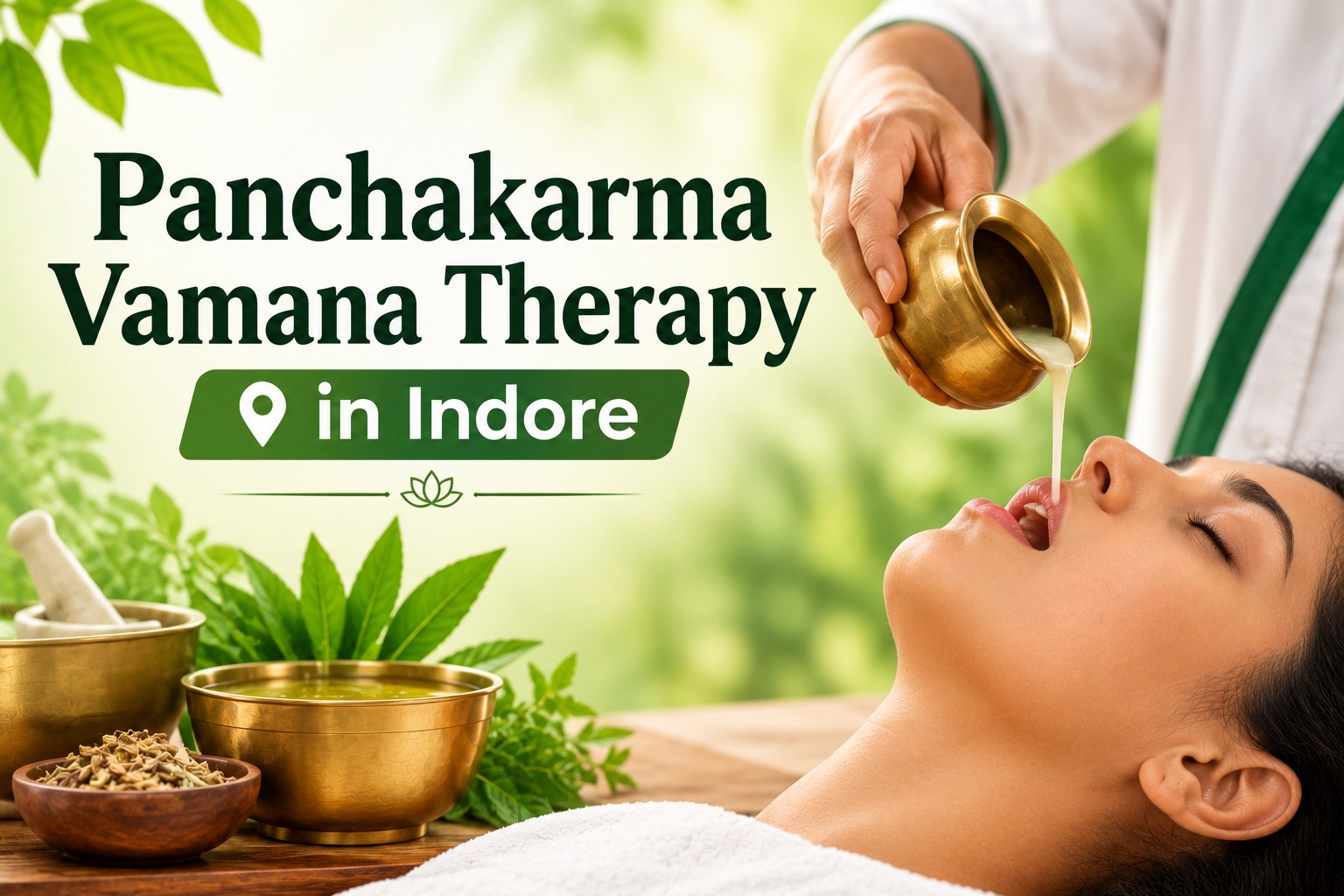
Vamana is one of the five principal Panchakarma purification procedures described in classical Ayurveda. It is a carefully supervised therapeutic emesis (medically induced vomiting) performed to eliminate aggravated Kapha Dosha from the body. Although the concept may seem unfamiliar from a modern perspective, Vamana is a structured clinical procedure that involves careful patient selection, preparation, administration, and post-therapy care under the guidance of a qualified Ayurvedic practitioner.
If you are considering Vamana therapy in Indore, it is essential to undergo a comprehensive Ayurvedic consultation before treatment. At our Ayurveda centre, experienced vaidyas assess your Prakriti (body constitution), symptoms, medical history, lifestyle, and overall health to determine whether Vamana is appropriate as part of a personalised Panchakarma treatment plan.
This page is intended for educational purposes and explains the classical principles, traditional procedure, indications, and safety considerations of Vamana. As it is a specialised Panchakarma therapy, Vamana should only be performed in an appropriate clinical setting under the supervision of a qualified Ayurvedic practitioner after an individual assessment. It is not a home remedy and is not suitable for everyone.
What Is Vamana?
In Ayurvedic physiology, Kapha is the dosha governing structure, mucus, stability and moisture, seated principally in the chest and stomach. When Kapha becomes excessively aggravated and accumulated — beyond what gentler measures can settle — classical texts describe Vamana as the definitive route to expel it directly through the upper pathway. The procedure uses specific medicated preparations to induce controlled therapeutic vomiting, understood to carry the excess Kapha out of the system.
Classically, Vamana is never a stand-alone act. It sits within a sequence — preparation, the main procedure, and graded recovery — and its success is judged by defined signs rather than simply by vomiting.
The Classical Rationale
Ayurveda holds that when a dosha is profoundly aggravated, removing the excess is more effective and lasting than merely pacifying it — much as clearing a source is more durable than repeatedly managing an overflow. For deep-seated Kapha disorders, Vamana is the shodhana (purification) matched to Kapha’s seat and direction. The aim is to restore doshic balance and, classically, to make the body more responsive to subsequent nourishing and strengthening care.
Classical Indications
Traditional texts describe Vamana as suited primarily to conditions of aggravated Kapha, including:
- Certain respiratory conditions with excess mucus, such as chronic cough and some presentations of asthma (in classical framing).
- Some chronic skin conditions understood as involving Kapha.
- Particular metabolic and Kapha-predominant disorders.
- As a seasonal or preparatory purification in appropriate constitutions, in classical practice.
These are classical indications, always subject to individual assessment by a qualified physician. Whether Vamana is appropriate for any given person and condition is a clinical judgement, not a self-diagnosis.
How Vamana Is Traditionally Performed
Classically the procedure follows a defined sequence:
- Preparation (Purvakarma) — internal oleation (snehapana) with medicated fats over several days, followed by sudation (swedana), to loosen and mobilise Kapha toward the stomach.
- Assessment of readiness — the practitioner confirms specific signs indicating the doshas are mobilised and the person is ready before proceeding.
- The main procedure (Pradhanakarma) — medicated emetic preparations are given under supervision on the chosen day, and therapeutic emesis is induced and monitored for defined signs of adequacy.
- Post-procedure care (Paschatkarma) — a carefully graded diet (samsarjana krama) rebuilds digestive strength gradually over days, alongside rest and specific lifestyle guidance.
Each stage requires professional supervision. The graded recovery diet is considered as important as the procedure itself, and skipping it is classically regarded as harmful.
Safety, Precautions & Who It Is Not For
Vamana is a potent procedure with clear classical contraindications. It is traditionally considered unsuitable for the very young and the elderly, in pregnancy, for those who are weak, severely depleted or emaciated, and for people with certain heart conditions, uncontrolled illness, or a tendency to bleeding, among others. Improper patient selection or technique can cause harm.
The essential safety message is simple: Vamana is a clinical procedure requiring individual assessment, proper facilities and expert supervision, with medical conditions and current medicines taken into account. It should never be attempted on the basis of a general article or without qualified guidance.
Frequently Asked Questions
What is Vamana in simple terms?
A supervised therapeutic emesis — one of Ayurveda’s five principal Panchakarma purification procedures — used classically to remove profoundly aggravated Kapha dosha from the body through the upper pathway.
Is Vamana just making someone vomit?
No — it’s a precise, staged medical procedure with days of preparation, careful patient selection, monitored emesis judged by specific signs, and an equally important graded recovery diet. It’s nothing like ordinary vomiting.
Where can I get the best Vamana therapy in Indore?
We offers best Vamana therapy in Indore as part of authentic Panchakarma treatment. Vamana is a classical Ayurvedic detoxification procedure performed under the supervision of experienced Ayurvedic doctors after a detailed consultation. For appointments, call +91 77778-38938.
What is Ayurvedic Vamana treatment in Indore?
Ayurvedic Vamana treatment in Indore is a traditional Panchakarma procedure that involves controlled therapeutic emesis using specially selected Ayurvedic medicines. It is performed only after proper preparation and a detailed Ayurvedic assessment.
What is Panchakarma Vamana therapy?
Panchakarma Vamana therapy in Indore is one of the five principal Panchakarma procedures. According to Ayurveda, it is primarily used to help balance Kapha dosha and is recommended only for suitable patients after consultation.
Do you provide Ayurvedic detox treatment in Indore?
Yes. We offer Ayurvedic detox treatment in Indore, including Vamana and other Panchakarma therapies, based on the patient’s body constitution (Prakriti), health condition, and treatment goals.
What is therapeutic emesis treatment in Ayurveda?
Therapeutic emesis treatment in Indore refers to Vamana, a medically supervised Ayurvedic cleansing procedure that induces controlled vomiting using prescribed herbal medicines. It should only be performed by qualified Ayurvedic professionals and should never be attempted without medical supervision.
For which conditions is Vamana therapy recommended?
According to Ayurvedic principles, Vamana may be recommended for selected patients with certain Kapha-related disorders, chronic respiratory conditions, allergic conditions, skin disorders, metabolic imbalances, and digestive concerns after proper evaluation.
Is Vamana therapy safe?
When performed by experienced Ayurvedic professionals after proper patient selection and preparation, Vamana therapy is generally considered safe. However, it is not suitable for everyone, and the Ayurvedic doctor will determine whether it is appropriate based on your health condition.
How long does the Vamana treatment process take?
The complete Vamana process includes preparation (Purva Karma), the main procedure, and post-treatment care (Paschat Karma). Depending on the patient’s condition, the entire process may take several days.
What precautions should I follow after Vamana therapy?
After Vamana, patients are usually advised to follow a prescribed diet, get adequate rest, stay hydrated, and follow all post-treatment instructions provided by the Ayurvedic doctor to support recovery and maintain the benefits of therapy.
How can I book an appointment for Vamana therapy in Indore?
To consult the experts at our Ayurveda centre for best Vamana therapy, or Ayurvedic detox treatment in Indore, call +91 77778-38938 to schedule your appointment. Our team will guide you through the consultation and personalized Panchakarma treatment plan.
What conditions is Vamana classically used for?
Classically, aggravated-Kapha conditions — certain respiratory conditions with excess mucus, some chronic skin conditions, and particular metabolic disorders — always subject to individual clinical assessment.
How long does the whole Vamana process take?
More than a single day — it includes several days of internal oleation and sudation beforehand and a graded recovery diet over days afterward, with the main emesis on one supervised day.
Why is the recovery diet so emphasised?
After purification, digestive strength is deliberately rebuilt in stages (samsarjana krama). Classical texts consider this graded diet as important as the procedure, and skipping it as harmful.
Who should not undergo Vamana?
Classically it’s unsuitable for the very young and elderly, in pregnancy, for the weak or severely depleted, and for those with certain heart conditions, uncontrolled illness or bleeding tendency, among others — individual assessment is essential.
Can I do Vamana at home?
No — it’s a potent clinical procedure requiring expert supervision and appropriate facilities. Attempting it without qualified guidance can cause harm and is strongly discouraged.
Is Vamana safe?
In appropriate candidates, with proper assessment, technique and supervision, it’s a recognised classical procedure; improper selection or technique can cause harm, which is why professional oversight is non-negotiable.
How does a practitioner decide if Vamana is right for me?
Through individual assessment of constitution, the condition, dosha involvement, strength, age, medical history and current medicines — a clinical judgement, never a self-diagnosis.
Does Vamana replace medical treatment?
No — it’s a classical Ayurvedic procedure that should complement, not replace, appropriate medical care, with any existing conditions and medicines accounted for by the supervising practitioner.
What is the difference between Vamana and other Panchakarma?
Vamana targets Kapha via therapeutic emesis; Virechana targets Pitta via purgation; Basti addresses Vata via medicated enema; each is matched to a dosha and its seat and direction in the body.
Is Vamana done in every Ayurvedic treatment?
No — it’s a specific purification indicated only in particular situations after assessment, not a routine part of every treatment. Many conditions are managed without it.
Learn More / Consult
This information is intended for general educational purposes only and should not be considered a substitute for an individual medical or Ayurvedic consultation. If you are looking for Vamana therapy in Indore, consult the experienced Ayurvedic doctors at our Ayurveda centre for a personalised assessment and treatment plan.
Call: +91 77778-38938
The clinic’s experienced vaidyas will assess your Prakriti (body constitution), symptoms, medical history, lifestyle, and overall health to determine whether Vamana therapy is appropriate for your condition and develop a personalised Ayurvedic treatment plan based on classical Ayurvedic principles.