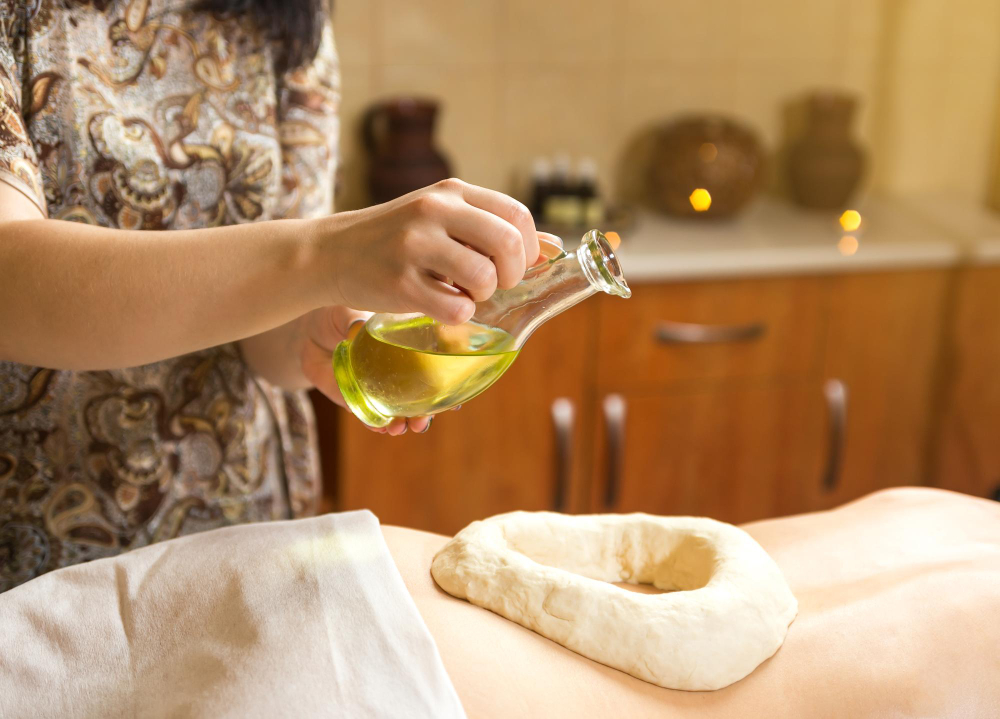
Kati Basti is a classical Ayurvedic therapy in which warm medicated oil is retained over the lower back within a specially prepared dough reservoir for a prescribed period. Although it shares the word “Basti”, it is different from the medicated-enema Basti used in Panchakarma. In this therapy, the term “Basti” refers to the retaining reservoir that holds the warm medicated oil over the affected area. It is one of the traditional localized oil-retention therapies used in Panchakarma in Indore, primarily for the lower back and lumbosacral region.
If you are considering Kati Basti therapy in Indore, it is important to undergo a proper Ayurvedic assessment before beginning treatment. At our Ayurveda centre, experienced vaidyas evaluate your Prakriti (body constitution), symptoms, lifestyle, posture, and overall health to determine whether Kati Basti is appropriate as part of a personalised Panchakarma treatment plan.
This page is intended for educational purposes and explains the classical principles, uses, and considerations of Kati Basti. While this therapy may support lower back health as part of an individualised Ayurvedic treatment plan, persistent, severe, or worsening back pain should always be evaluated by a qualified medical professional to identify the underlying cause.
What is Kati Basti?
The procedure builds a small wall of kneaded dough (usually black gram flour) in a ring over the lower back, creating a well. Warm medicated oil is poured in and kept comfortably warm, held in place over the area for a defined period. The sustained contact of warm medicated oil with the lower back is the essence of the therapy.
In Ayurvedic terms, the lower back is a Vata-predominant region, and Kati Basti’s warm oil is aimed at pacifying local Vata, easing stiffness and supporting the tissues of the area.
The Classical Rationale
Vata governs movement and the nervous system and, when aggravated, produces dryness, stiffness and pain — qualities especially relevant to the lower back. Warm oil, being the opposite in quality, is classically held to pacify local Vata, nourish and soften the tissues, and ease stiffness and discomfort in the region. Concentrating sustained warm oil over one area allows a focused local effect that general massage may not achieve.
Classical Indications
Kati Basti is classically associated with lower-back and lumbosacral complaints, including:
- Chronic low back stiffness and discomfort of Vata origin, in classical framing.
- Complaints associated with the lumbosacral region.
- Stiffness and reduced ease of movement in the lower back.
- As localized supportive therapy within a broader Ayurvedic plan for back-related conditions.
These are classical associations requiring individual assessment. Significant or persistent back pain — and any back pain with warning features — needs medical evaluation, with Kati Basti as supportive rather than sole care.
How Kati Basti Is Traditionally Performed
- Reservoir preparation — a ring of kneaded dough is built over the lower back to form a sealed well, with the person lying face down.
- Warm oil pooling — warm medicated oil is poured into the well and kept at a comfortable, safe temperature, topped up or reheated to maintain warmth.
- Retention — the oil is retained over the area for a defined period, allowing sustained warm contact with the lower back.
- Completion and after-care — the oil and dough are removed, the area gently cared for, and rest and guidance follow; it is often given as a course.
Comfortable, safe oil temperature and appropriate oil selection are essential; it is commonly repeated over several sessions.
Practical Considerations & Precautions
Kati Basti is generally gentle, but sensible cautions apply: safe oil temperature to avoid burns, care over broken or infected skin, and attention to any allergies and specific medical conditions. Crucially, back pain has many causes — some needing prompt medical attention — so Kati Basti should not substitute for diagnosis. Back pain with leg weakness, numbness, loss of bladder or bowel control, fever, unexplained weight loss, or following significant injury needs urgent medical evaluation, not a localized oil therapy.
Frequently Asked Questions
Where can I get Kati Basti Therapy in Indore?
We offers Kati Basti Therapy in Indore as part of authentic Panchakarma treatment. This therapy involves retaining warm medicated oil over the lower back to support spinal health and relieve discomfort. For appointments, call +91 77778-38938.
What is Ayurvedic Kati Basti treatment in Indore?
Ayurvedic Kati Basti treatment in Indore is a traditional Panchakarma therapy in which warm medicated oil is retained over the lower back using a specially prepared herbal dough ring. The therapy is recommended after an Ayurvedic assessment based on the patient’s condition.
Can Ayurveda help with back pain?
Yes. We provide Ayurvedic back pain treatment in Indore through personalized care that may include Kati Basti, herbal medicines, therapeutic massage, Panchakarma therapies, dietary guidance, and lifestyle modifications to support spinal health and mobility.
Is Panchakarma beneficial for lower back pain?
Yes. Panchakarma for lower back pain in Indore may include Kati Basti and other supportive Ayurvedic therapies depending on the patient’s symptoms, diagnosis, and overall health. The treatment plan is customized after consultation with an Ayurvedic doctor.
Do you provide Ayurvedic treatment for sciatica in Indore?
Yes. We offer Ayurvedic treatment for sciatica in Indore using individualized treatment plans that may include Kati Basti, herbal medicines, Panchakarma therapies, and lifestyle recommendations to support nerve and spine health. Patients with severe or progressive symptoms should also seek appropriate medical evaluation.
What conditions can Kati Basti help manage?
Kati Basti may be recommended for lower back pain, lumbar spondylosis, muscle stiffness, sciatica, disc-related discomfort, and reduced lower back mobility after a proper Ayurvedic assessment.
How long does a Kati Basti session take?
A typical Kati Basti session usually lasts 30 to 45 minutes, depending on the patient’s condition and the treatment plan prescribed by the Ayurvedic doctor.
Is Kati Basti therapy safe?
When performed by qualified Ayurvedic professionals after proper consultation, Kati Basti is generally considered a safe Panchakarma therapy. The treatment is customized according to each patient’s health condition.
How many Kati Basti sessions are required?
The number of sessions depends on the severity of the condition, the patient’s overall health, and individual response to treatment. After evaluation, our Ayurvedic doctor will recommend a personalized therapy schedule.
How can I book an appointment for Kati Basti Therapy in Indore?
To consult the experts at our Ayurveda centre for Kati Basti Therapy, Ayurvedic back pain treatment, Panchakarma for lower back pain, or Ayurvedic treatment for sciatica, call +91 77778-38938 to schedule your appointment. Our team will guide you through the consultation and personalized treatment process.
What is Kati Basti?
A localized Ayurvedic therapy where warm medicated oil is pooled and retained over the lower back within a dough reservoir for a set period, aimed at easing lower-back stiffness and pacifying local Vata.
Is Kati Basti the same as the enema Basti?
No — despite the shared word, ‘basti’ here means the retaining reservoir of dough. It’s a localized external warm-oil therapy for the lower back, unlike the medicated-enema Basti of Panchakarma.
What is Kati Basti used for?
Classically for chronic lower-back stiffness and discomfort of Vata origin and lumbosacral complaints, as localized supportive therapy alongside proper medical evaluation where back pain is significant.
How does warm oil help the back?
The lower back is a Vata-predominant region, and warm oil — opposite in quality to Vata’s cold, dry nature — is classically held to pacify local Vata, soften tissues and ease stiffness in a focused way.
Is Kati Basti safe?
Generally gentle, provided the oil temperature is safe, skin is intact, and allergies and medical conditions are considered. Its main limitation is that it shouldn’t replace diagnosis of the cause of back pain.
How many sessions are needed?
It’s commonly given as a course over several sessions, individualized to the person and condition, as advised by the practitioner.
Can Kati Basti cure my back pain?
It’s best regarded as supportive care that may ease stiffness and discomfort, not a cure. The underlying cause of persistent back pain should be properly evaluated medically.
When is back pain a medical emergency?
Back pain with leg weakness or numbness, loss of bladder or bowel control, fever, unexplained weight loss, or after significant injury needs urgent medical evaluation — not a localized oil therapy.
Which oils are used in Kati Basti?
Warm medicated oils selected according to the individual and condition; a practitioner advises on the appropriate oil for the region and purpose.
Does Kati Basti help sciatica?
It may be used as localized supportive care for lower-back complaints in classical practice, but sciatica should be medically evaluated, with Kati Basti complementing rather than replacing appropriate treatment.
Is there any preparation needed?
Usually minimal — it’s an external therapy — but the practitioner assesses suitability, selects the oil, and advises on any preparation and after-care.
Does Kati Basti replace medical treatment?
No — it’s a supportive localized therapy; persistent or significant back pain warrants proper medical evaluation, which Kati Basti can complement but not substitute.
Learn More / Consult
This information is intended for general educational purposes only and should not be considered a substitute for an individual medical or Ayurvedic consultation. If you are considering Kati Basti therapy in Indore or looking for authentic Panchakarma in Indore, consult the experienced Ayurvedic doctors at our Ayurveda centre for a personalised assessment and treatment plan. Call: +91 77778-38938
The clinic’s experienced vaidyas will assess your Prakriti (body constitution), symptoms, lifestyle, and overall health to determine whether Kati Basti or other appropriate Panchakarma therapies are suitable for your condition and create a personalised Ayurvedic treatment plan.